Technical Hiring
GitHub Candidate Sourcing: How Recruiters Can Find Technical Talent
Most candidate profiles tell recruiters what people say they do. GitHub can add another layer by showing some of the technical work developers choose to make public. That public activity is useful evidence during discovery and research. It is not a complete picture of someone's career, skill level, or interest in changing jobs.
Sourcing on GitHub is how you discover additional candidates. Research is how you interpret public technical evidence for people already in your search or pipeline. Neither proves quality. You decide who deserves a closer look.
This article explains what GitHub candidate sourcing is, what public GitHub activity can and cannot tell a recruiter, and how GitHub fits alongside LinkedIn and sourcing tools in a broader technical candidate sourcing workflow.
What is GitHub candidate sourcing?
GitHub candidate sourcing is the practice of using public GitHub profiles, repositories, and contribution activity to discover and research potential technical candidates. Recruiters use this evidence to understand technologies someone appears to work with, open-source participation, and public projects. GitHub should complement professional history, screening, and direct conversations rather than replace them.
GitHub is not a CV database. A profile may show strong public work, little public work, or work that does not reflect someone's day job. Treat what you find as technical evidence to investigate, not as a scorecard.
Why recruiters use GitHub for technical sourcing
Recruiters turn to GitHub when they need signals beyond self-reported skills:
Developers who may not maintain detailed LinkedIn profiles. Many strong engineers spend more time building than optimizing a professional profile. Public code, issues, and pull requests can surface people who would never appear in a keyword search on a job board.
Visible technical work. Repositories, commit history, and collaboration on open source can show how someone structures projects, communicates in technical discussions, and maintains work over time.
Technology clues. Language statistics, dependency choices, and the types of repositories someone contributes to can suggest stacks they have worked with in public contexts.
Open-source contributors. Active contributors to projects your team relies on may already understand adjacent problems. That is a discovery path, not a guarantee of fit.
Evidence for candidate research. Sourcing is finding additional candidates. Research is different: when someone is already in your pipeline or search process, a GitHub profile can add public technical context before you reach out. It does not prove skill or quality. When you read that evidence, look briefly at repository ownership, whether activity is repeated or one-off, and pull-request or review context - then go deeper in Reading a GitHub Profile as a Recruitment Signal.
Not every developer has a useful GitHub profile. Some excellent engineers keep most work private, contribute under employer accounts you cannot link to a person, or simply prefer not to publish side projects. GitHub sourcing works best when you treat absence of public activity as missing evidence, not as proof someone is weak.
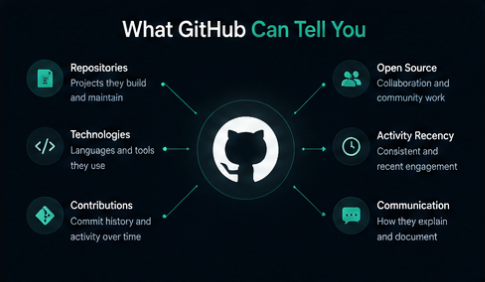
What can GitHub tell you about a developer?
Public GitHub activity can support informed research when read in context. Here is what recruiters commonly look at and how to interpret it carefully.
Repositories and projects
Pinned repositories and owned projects show what someone chooses to highlight. Read README files, project structure, and whether repos look maintained or abandoned. A polished side project can demonstrate initiative. A fork with no changes tells you little.
Languages and technologies
GitHub surfaces language breakdowns based on public repositories. That can suggest technologies someone has worked with in public code. It does not prove depth in every listed language, and it may miss technologies used only in private repositories.
Contributions
Contribution graphs, commit patterns, and pull requests to other projects show participation over time. Look for consistency and relevance to your role rather than raw volume. A burst of activity years ago is different from steady contributions in the last twelve months.
Open-source collaboration
Contributions to shared projects can show how someone works with others: issue comments, review feedback, and follow-through on pull requests. Collaboration style matters for team fit, but public OSS norms differ from every workplace.
Recency and consistency of public activity
Recent activity suggests current engagement with technical work in public. Long gaps may mean private employment, burnout, career change, or simply that public GitHub is not where they work. Context matters more than the gap alone.
Documentation and communication
README quality, issue descriptions, and discussion tone can reveal how clearly someone explains technical decisions. That is often more useful for recruiter research than counting commits.
Interpret with caution. A large number of commits does not automatically mean someone is senior or highly skilled. A quiet GitHub profile does not mean someone is a weak engineer. Stars on a repository reflect interest in the project, not a hiring recommendation for every contributor.
What GitHub cannot tell a recruiter
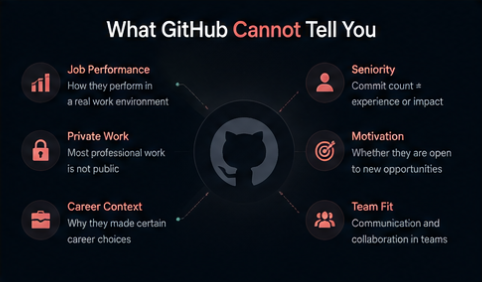
This section matters as much as the signals above. Over-reading GitHub leads to false confidence and missed candidates.
Private professional work is often invisible. Most production code lives in private repositories. Someone may be a strong engineer whose GitHub profile looks empty because employer policy or habit keeps work off the public web.
GitHub activity does not equal seniority. Junior developers with active side projects can look busier than senior engineers focused on architecture in closed systems. Commit counts and green squares are weak proxies for level.
Activity does not prove job performance. Public repos show a slice of someone's work under self-chosen conditions. They do not show how someone performs under your team's constraints, priorities, or codebase.
Activity does not show whether someone wants a new job. A developer with an active profile may be happily employed and not open to outreach. Inactivity does not mean someone is available either.
Some excellent developers have little or no public activity. Privacy preference, non-coding leadership roles, or stacks that never touch GitHub are all normal. Do not treat GitHub as a filter that removes anyone without a public footprint.
Commit volume is a poor standalone hiring metric. Volume can reflect automated commits, trivial changes, or rebases. Without reading context, counting commits misleads.
Context matters. A hobby project in an unrelated stack is not professional experience. A contribution to a famous repo might be a one-line typo fix. Always read what the activity actually involved.
How recruiters find candidates through GitHub
Recruiters discover technical candidates on GitHub through several high-level paths. For step-by-step search workflows, see How to Find Developers on GitHub: A Recruiter's Guide.
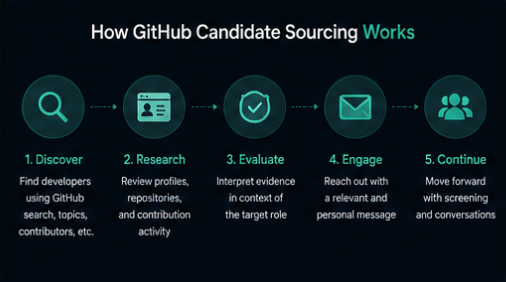
GitHub profiles. Search and browse user profiles filtered by location, primary repository language, and other public profile fields. GitHub's user search documentation describes available qualifiers.
Repositories. Find projects aligned with your stack, then inspect contributors, maintainers, and recent activity.
Contributors and organizations. Canonical open-source projects and company organizations can reveal people working in public on relevant technologies.
Technology and language clues. Language tags, topics, and dependency patterns help narrow discovery when combined with other filters.
Public search. GitHub search and API-based workflows can surface users and repos, with practical limits on result volume and how profile fields are indexed.
Sourcing platforms. Tools in the GitHub sourcing category aggregate discovery and research workflows so recruiters spend less time on repetitive profile review. They vary in scope, sources, and how much human review they expect.
For how to evaluate those tools, see Best GitHub Candidate Sourcing Tools for Recruiters in 2026.
Manual GitHub sourcing vs sourcing tools
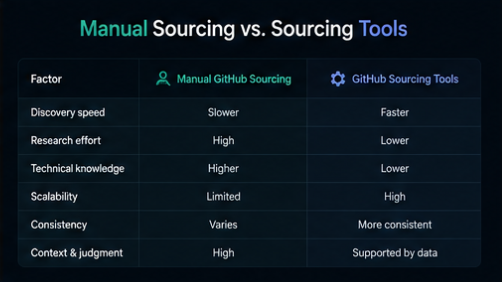
Both approaches have a place. The right choice depends on role urgency, volume, and how much technical context your team already has.
| Manual GitHub sourcing | GitHub sourcing tools | |
|---|---|---|
| Discovery speed | Slow for broad searches; fast when you already know a target repo | Faster for repeated discovery against role criteria |
| Research effort | High: each profile opened and judged individually | Lower for initial shortlists; review still required |
| Technical knowledge required | Enough to judge repos, languages, and activity context | Less depth needed when tools summarize public evidence |
| Context | You see full nuance when you read carefully | Depends on what the tool surfaces; may miss nuance |
| Enrichment | Manual cross-checking with other sources | May combine GitHub with other public technical sources |
| Repeatability | Hard to standardize across recruiters | Easier to repeat against role profiles |
| Scale | Poor beyond a handful of roles | Better when hiring volume or niche stacks multiply searches |
Manual sourcing makes sense for a single critical hire, a known repository, or when a sourcer already has deep stack context. Tooling becomes useful when your team runs many technical searches or needs consistent evidence packets. For evaluation criteria, tool categories, and when platforms win, see Best GitHub Candidate Sourcing Tools for Recruiters in 2026.
GitHub sourcing vs LinkedIn sourcing
LinkedIn and GitHub answer different questions. They work best together.
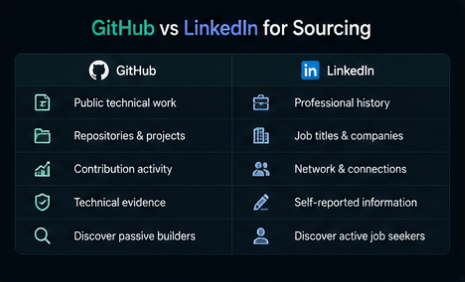
LinkedIn primarily represents professional identity and career history: job titles, employers, tenure, and self-described skills. GitHub can provide public technical-work evidence: repositories, contribution activity, and open-source collaboration.
| GitHub | |
|---|---|
| Professional history and job titles | Public technical projects |
| Company names and career narrative | Repository and contribution activity |
| Professional networking and messaging | Open-source collaboration patterns |
| Self-reported skills | Evidence from public code and discussions |
Both have limits. LinkedIn profiles can overstate scope and underrepresent hands-on work. GitHub profiles can omit years of private employment. Neither shows whether someone is open to opportunities.
For why many strong developers maintain minimal LinkedIn presence and where they show work instead, see Why Great Developers Are Invisible on LinkedIn (And Where to Find Them).
Common GitHub sourcing mistakes
Treating stars as candidate quality. Stars measure project popularity, not individual engineer level.
Treating commit volume as productivity. Volume without context is noise.
Assuming inactivity means lack of skill. Private work, career stage, and personal preference all produce quiet profiles.
Searching only exact job-title keywords. Developers rarely label themselves "Senior Backend Engineer" on GitHub. Search by technology, contribution, and project context instead.
Ignoring context. Read what changed, not just that something changed.
Confusing hobby projects with professional experience. Side projects are signal, not a substitute for verifying relevant production work when you need it.
Assuming public activity equals candidate interest. Activity shows engagement with technical work, not job-search intent.
Relying on GitHub alone. Strong technical candidate sourcing combines multiple public sources and professional history.
Using public technical evidence beyond GitHub
GitHub is one part of a wider technical footprint. Recruiters doing technical candidate sourcing often combine several public sources:
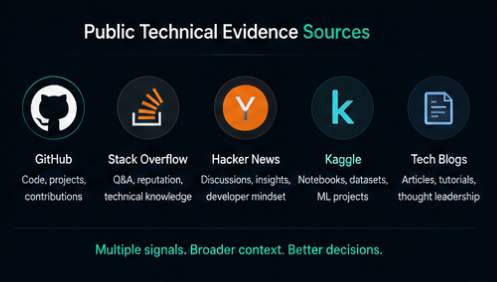
Stack Overflow for community-validated answers and tag-level depth. See How to read a Stack Overflow profile like a hiring signal.
Hacker News for technical discussion and curiosity signals.
Kaggle for public data science and ML activity where relevant.
Technical blogs for long-form explanations of hard problems.
Different strengths appear in different places. A backend engineer might be quiet on GitHub but active on Stack Overflow. A data scientist might show more on Kaggle than in public repos. Multi-source research reduces false negatives.
Sonar Air is built around that idea: public technical evidence from several sources, reviewed by recruiters rather than treated as a single-platform ranking.
How Sonar Air approaches GitHub candidate sourcing
Sonar Air is a technical evidence research and candidate discovery platform for recruiters - the technical evidence layer for your recruiting stack. It works alongside existing recruiting and sourcing tools and uses public technical evidence from GitHub, Stack Overflow, and other places where developers build and contribute. A Free plan (€0) covers one seat, one role, and one scan per month so a team can try this on a real hire. Access is currently invite-only while self-serve billing is being tested; request access or book a demo.
Rather than treating GitHub as a replacement CV, Sonar Air uses public technical activity as evidence during candidate discovery and research. Recruiters define role profiles, run evidence-backed scans, and review matches with links to the public work behind each recommendation. GitHub is an important discovery source, alongside Stack Overflow, Hacker News, Kaggle, and technical blogs.
Sonar Air is not a GitHub-only tool. It is designed for teams that want multi-source public technical evidence, with recruiters deciding who deserves a closer look before outreach.
Learn more about supported data sources and how Sonar Air works.
Is GitHub candidate sourcing right for every role?
GitHub candidate sourcing tends to be most useful when public technical work is common in the role:
- Software engineering and platform development
- DevOps and infrastructure roles with public tooling involvement
- Open-source-heavy stacks and ecosystems
- AI/ML roles where candidates publish notebooks, models, or experiments
- Data and technical roles with relevant public repositories or competitions
It often provides much less evidence for roles where work stays private, regulation limits public sharing, or the job is far from code-centric work. Even for engineering roles, treat GitHub as one input among screening, interviews, and references.
Frequently asked questions
What is GitHub candidate sourcing?
GitHub candidate sourcing means using public GitHub profiles, repositories, and contributions to discover and research technical candidates. Recruiters examine public activity for technology clues, project evidence, and collaboration patterns. It supports hiring research; it does not replace interviews or professional background checks.
Can recruiters legally search public GitHub profiles?
Public GitHub profiles and repositories are visible to anyone on the web by design. Recruiters commonly use that public information for sourcing research. If you store or process personal data, especially in the EU, your organization may have GDPR obligations around purpose, retention, and candidate rights. This is not legal advice; consult qualified counsel and your internal policies. See GitHub's privacy statement for how GitHub handles user data on its platform.
Can you find developers by location on GitHub?
GitHub user search supports a location: qualifier based on the location field on a user's profile. GitHub documents this search syntax. Location is free text, may be outdated, and is not verified. Use it as a hint, not a precise filter.
Is GitHub better than LinkedIn for sourcing developers?
GitHub and LinkedIn serve different purposes. LinkedIn is stronger for professional history and career context. GitHub is stronger for public technical-work evidence. Most recruiting teams use both, plus other public sources, rather than replacing one with the other.
What should recruiters look for in a GitHub profile?
Look for relevant repositories, README clarity, ownership versus one-off forks, recent activity, and collaboration in issues and pull requests. Prioritize fit to your role's technologies over vanity metrics like stars or raw commit counts. For a fuller reading pass, see Reading a GitHub Profile as a Recruitment Signal.
Do you need technical knowledge to source developers on GitHub?
You need enough context to judge whether activity is relevant, recent, and meaningful. You do not need to read every line of code. README files, project descriptions, languages used, and discussion tone often give recruiters sufficient signal for initial research.
What tools can help recruiters source candidates from GitHub?
Tools range from GitHub's own search and API workflows to sourcing platforms that combine GitHub with other public technical evidence. See Best GitHub Candidate Sourcing Tools for Recruiters in 2026 for evaluation criteria and when manual search beats platforms.
How do you source technical candidates on GitHub?
Recruiters source technical candidates on GitHub by searching public profiles, repositories, and contributors, then reviewing languages, recent activity, and collaboration in issues and pull requests. Treat that public work as evidence to research, not as a scorecard. Many teams also combine GitHub with Stack Overflow, Hacker News, Kaggle, and technical blogs - or use a sourcing platform such as Sonar Air that gathers public technical evidence for recruiter review.
Which platforms besides GitHub help with technical candidate sourcing?
Besides GitHub, recruiters often use Stack Overflow for community-validated answers, Hacker News for technical discussion, Kaggle for data and ML work, and technical blogs for long-form explanations. Different engineers show strength in different places, so multi-source research reduces missed candidates.
For a dedicated guide on reading GitHub profiles as recruitment signals without over-interpreting public activity, see Reading a GitHub Profile as a Recruitment Signal.
For a dedicated guide on evaluating sourcing platforms, see Best GitHub Candidate Sourcing Tools for Recruiters in 2026.
Final takeaway
GitHub helps recruiters discover and understand technical candidates through public evidence. Used well, it adds context that professional profiles alone may miss. Used poorly, it becomes a shallow scorecard that rewards visibility over fit.
Treat GitHub as one layer in technical candidate sourcing: discover in public, verify through conversation, and combine GitHub with professional history and other public technical sources. That is how GitHub candidate sourcing supports better hiring decisions without pretending a profile tells the whole story.
Sonar Air team
Writes about evidence-based technical recruiting and multi-platform developer sourcing at Sonar Air.
About Sonar AirNext in the series
How to Find Developers on GitHub: A Recruiter's Guide →Back to blog