Evidence series · Post 4 of 8
How to read a Stack Overflow profile like a hiring signal
For technical recruiters placing software engineers
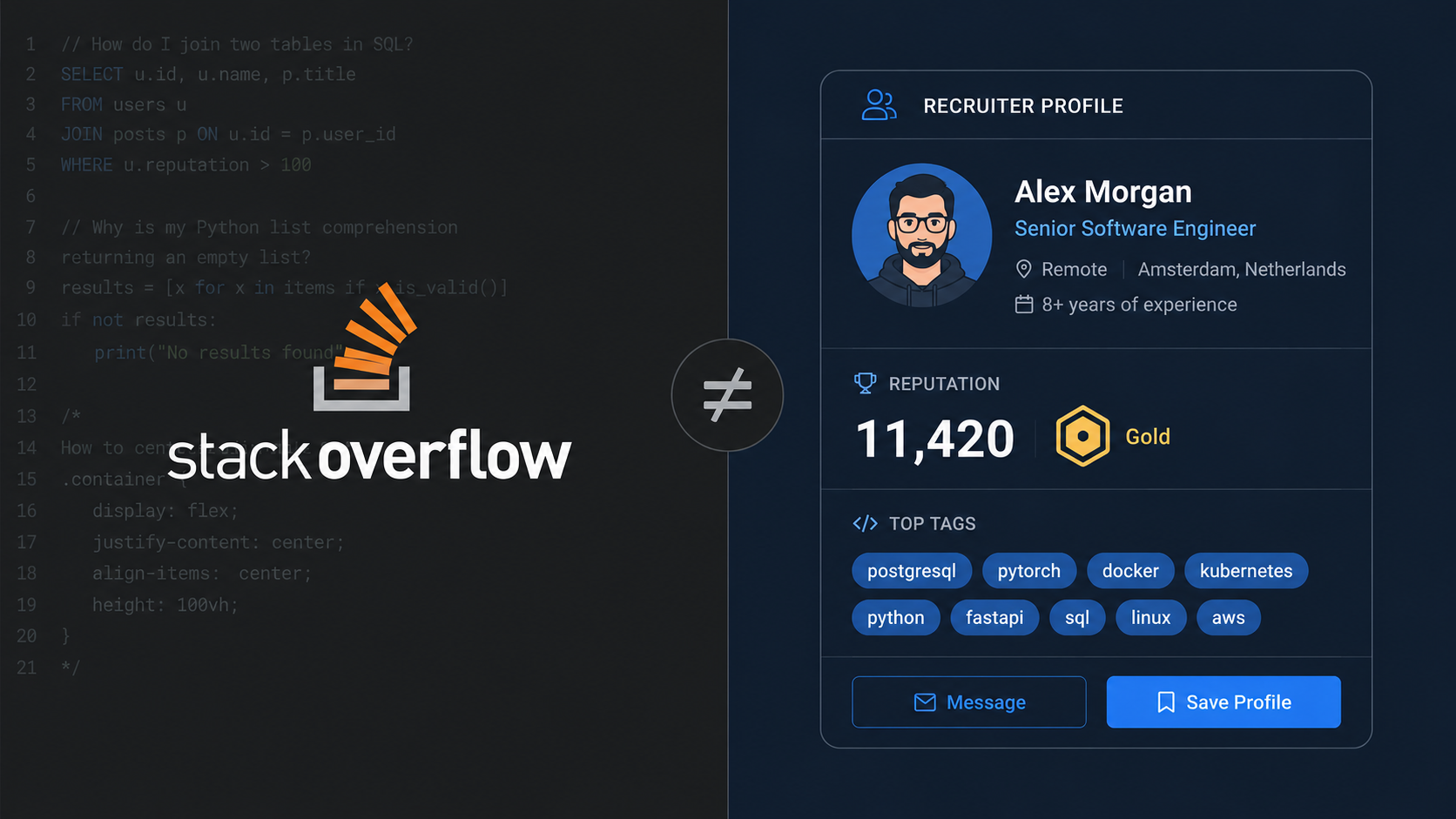
Stack Overflow reputation is one of the most misread numbers in technical recruiting. A 50,000-reputation account can be shallow volume. A 3,000-reputation account with deep tag concentration can be much more useful research evidence. It is still not a hire decision.
The difference is what's behind the number. Reputation is a byproduct of activity. What matters is which activity, in which tags, on which type of questions - and whether the person is answering or just asking.
This post shows you how to read a Stack Overflow profile the way a recruiter with good technical instincts would. Not the score. The pattern. The same discipline applies when you read a GitHub profile as public evidence: look at the work, not the headline number.
First: why Stack Overflow profiles still matter in 2026
You've probably heard that Stack Overflow is dying. Traffic is down. New questions are rare. That's true - but it's only half the story, and the half that matters least for sourcing.
Here's what actually happened. When AI coding tools took off after 2022, beginner and mid-level questions migrated to ChatGPT and Copilot. What's left on Stack Overflow is increasingly niche, legacy-system, and security-sensitive problems - exactly the categories where AI tools fall short. The generalists left. The specialists stayed.
Stack Overflow licensed content to AI providers, including a 2024 OpenAI OverflowAPI partnership. Earlier public dumps were also widely used in model training. The knowledge did not disappear; much of it moved into tools. The people who built that knowledge base left public profiles.
The decline in Stack Overflow activity is a filter, not a graveyard. The people still showing up with active, high-quality profiles are the ones who were there before it was easy - and built real reputations through genuine contribution.
What's actually on a Stack Overflow profile
Stack Overflow shut down its recruiter Jobs feature in 2022. There's no sourcing dashboard. You're reading a public profile directly. If a bio links to GitHub, treat that as another public-evidence source - GitHub candidate sourcing covers how recruiters work with that activity. Here's what you're looking at:
| Field | What it tells you |
|---|---|
| A - Reputation | Cumulative upvotes minus downvotes. High reputation usually means many positively received posts. It does not prove depth in your stack. |
| B - Top tags | The technologies they actually answered questions about, ranked by score. This is the most useful section. |
| C - Gold badge | Requires 200+ answers and 1,000+ cumulative score in one single tag. Hard to fake at scale; still not a hire score. |
| D - Answers vs. questions ratio | A high answer count relative to questions means a contributor, not just a consumer. |
| E - About + links | Free text. Often includes GitHub, personal site, or LinkedIn. Same username across platforms is common - worth searching. |
The screenshot below maps directly to A through E on an illustrative profile. Read the fields first - then read the pattern underneath.
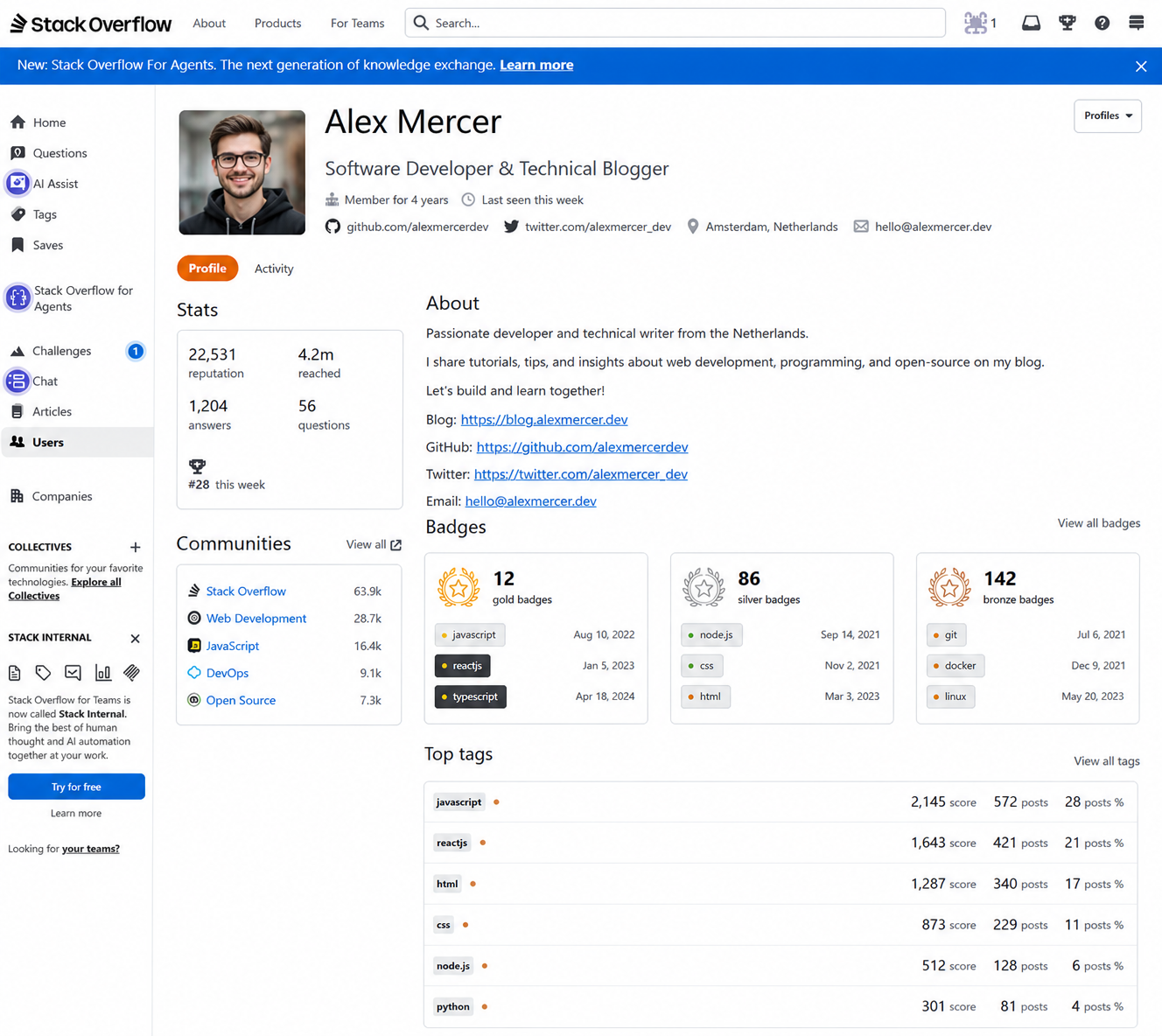
Alex Mercer: reputation 22,531, top tags ranked by score, 12 gold badges (javascript, reactjs, typescript), 1,204 answers vs 56 questions, GitHub in the bio. Every field from A-E is visible - but the spread across five web tags is the pattern to notice, not the headline number.
Reputation count vs. answer quality - the number that misleads
High reputation doesn't mean deep expertise. It usually means prolific. Someone with 80,000 reputation might have got there answering thousands of beginner questions - "how do I center a div" - over ten years. That's volume. Volume isn't depth.
Strong signal
- High score on a narrow specialist tag
- Accepted answers on hard, niche questions
- Gold badge in one technology
- Questions that reveal advanced thinking
- Concentrated: few tags, high scores
Weak signal
- High total reputation spread across many tags
- Answers on beginner "how to" questions
- Gold badges only in broad, popular tags (javascript, html, css)
- Only questions, zero answers
- Spread thin: 10+ tags, low scores each
A gold badge in
[postgresql]requires 200+ answers with 1,000+ community upvotes in that single tag. That is strong community-validated depth in one tag. It is still public evidence to research, not a hiring verdict.
Questions asked vs. answers given - both are signal
Most recruiters only look at answers. That's a mistake. Questions tell you something different.
Someone who asks precise, well-formed questions about hard problems is showing you their cognitive style. They've done the research. They know what they don't know. They articulate problems clearly. That matters for any senior engineering role that involves technical communication - which is almost all of them.
A profile with only questions and no answers is weaker. It suggests a consumer of the community, not a contributor. But a profile with both - solid answers in one specialist area, and well-framed questions at the edges of that expertise - is someone actively working at the boundary of what they know. That's the profile worth reading closely.
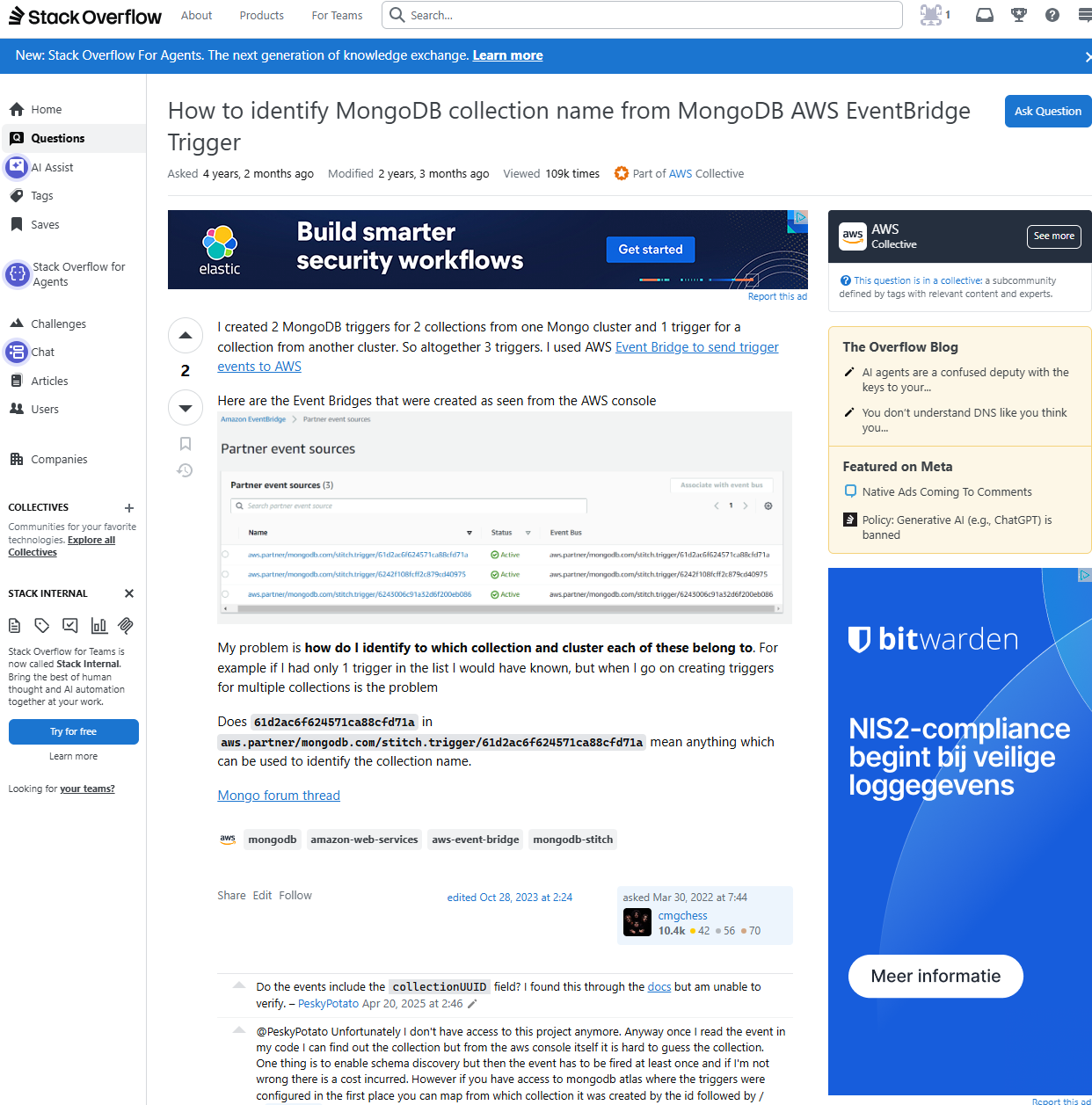
A well-framed question about identifying which MongoDB collection and cluster an EventBridge trigger belongs to - across two clusters, with an AWS console screenshot and specific partner event source IDs. Tags match the integration problem. That's signal before you read the answers.
How to filter for depth: the tag score method
Don't look at overall reputation first. Go straight to the top tags section. You're looking for three things.
Concentration in one specialist tag. A backend engineer with 4,000 points in [postgresql] and 200 in everything else is more interesting than someone with 800 points each in fifteen tags. Depth over breadth.
Accepted answers in that tag. Click through and read a few. Are the answers explaining the reasoning, or just pasting code? Reasoning is the signal. Code without explanation is cheaper to produce.
Tag difficulty. Questions tagged [gcc], [assembly], [cuda], or [memory-management] attract a different level of answerer than [html] or [css]. The tag tells you the territory. The territory tells you the ceiling.
The profile below shows what that pattern looks like in practice: one dominant tag, a steep drop-off in the rest, and gold badges earned inside one coherent technology family.
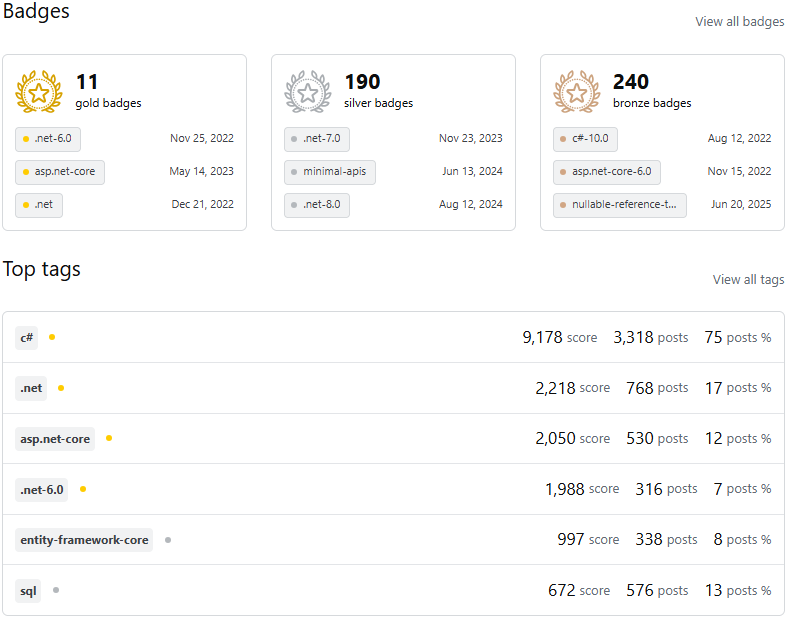
c# leads at 9,178 score (75% of posts). Gold badges in c#, .net, asp.net-core, and .net-6.0 - one .NET stack, not five unrelated tags at similar scores. entity-framework-core and sql sit far below the lead tag. This is concentration.
Three profile patterns - two strong, one misleading
These are composite sketches based on real patterns. Names are fictional. Profile A and B show what strong specialist signal looks like. Profile C shows what wins a five-second scan but misleads on depth.
Profile A - The database specialist
- ~11,400 reputation
- Gold badge: postgresql (6,240 pts)
- 342 answers · 28 questions · 6 years member
Answers focus on query planner behaviour, VACUUM scheduling, and partial index design. Acceptance rate around 72%. Asks advanced questions about replication edge cases. GitHub linked in bio.
Verdict: Concentration in one specialist tag. High acceptance rate. Answers that explain reasoning, not just code. For a data-infrastructure search, this pattern belongs on the shortlist. Then verify in conversation.
Profile B - The ML practitioner
- ~6,800 reputation
- Gold badge: pytorch (3,920 pts)
- 120 answers · 4 years member
Answers land on custom training loops, loss function debugging, and CUDA memory errors. Low total reputation, but the questions are in places only practitioners go. GitHub linked - public repos with training experiments.
Verdict: Total reputation is modest, but CUDA memory errors are not a beginner topic. This profile suggests experience with practitioner-level PyTorch/CUDA topics, not tutorial-level work.
Profile C - Looks good, isn't
- ~22,500 reputation
- 12 gold badges: javascript, reactjs, typescript
- 1,204 answers · 56 questions
Top tags spread across javascript (2,145), reactjs (1,643), html (1,287), css (873), and node.js (512) - gradually declining, no steep concentration. Gold badges in popular web stacks. GitHub linked in bio.
Verdict: Impressive headline numbers and a healthy answer ratio. Prolific generalist frontend signal. Misleading if you need deep specialist expertise.
Here is the same lesson with illustrative names side by side. On the left, Alex Mercer - the Profile C pattern from above. On the right, Priya Nair - the Profile A pattern. Lower headline numbers on the right. Stronger specialist signal.
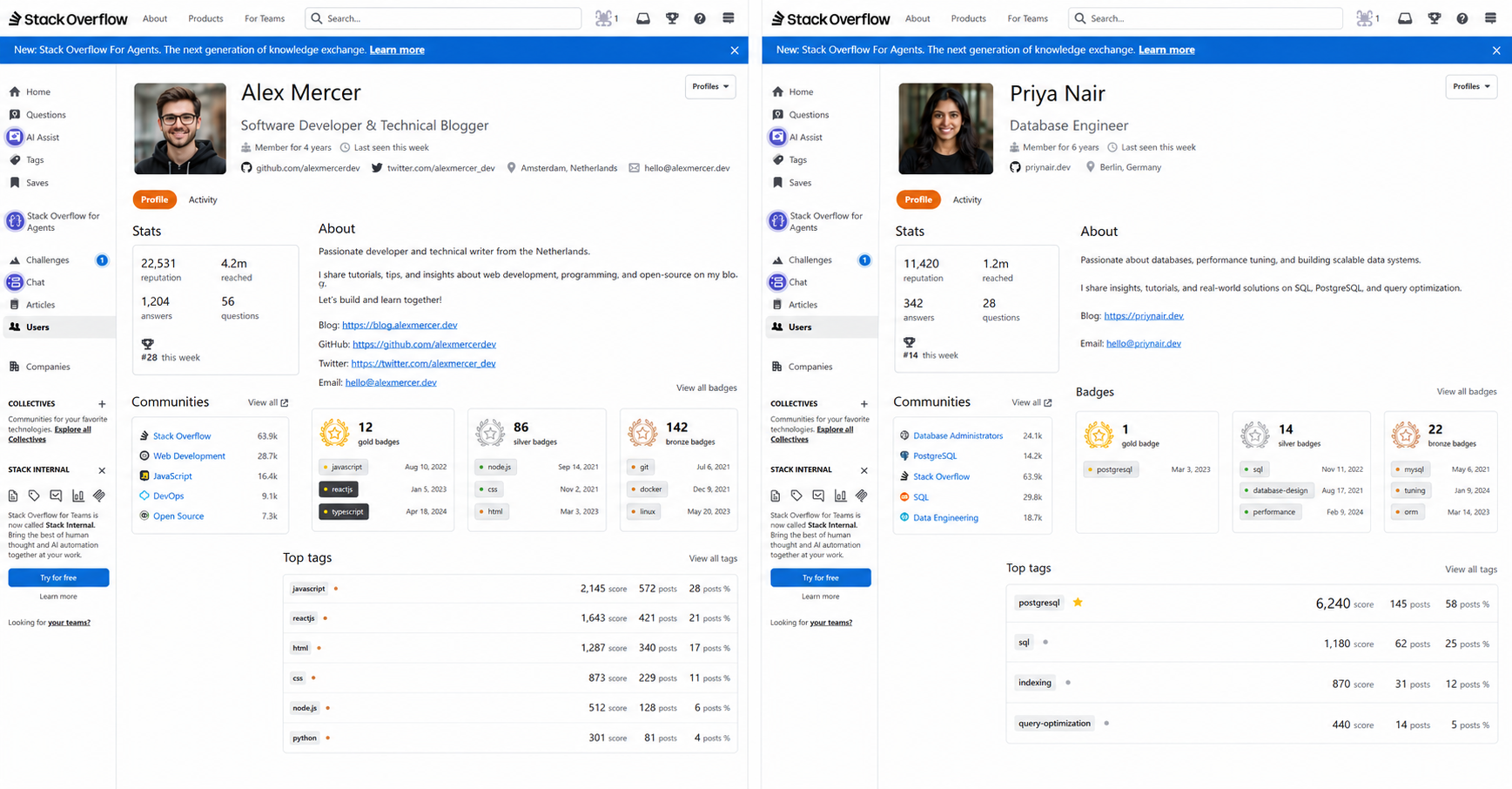
Left: Alex Mercer - high reputation, tags spread across five web technologies. Right: Priya Nair - lower total reputation, steep concentration in postgresql. For a data-infrastructure search, Priya's pattern is the stronger shortlist signal. Then verify in conversation.
Alex Mercer - the misleading profile
Good on the surface: 22,531 reputation, 12 gold badges, 1,204 answers. Big numbers. This is the profile that looks impressive in a five-second scan.
What's actually weak:
- Top tags spread across javascript (2,145), reactjs (1,643), html (1,287), css (873), node.js (512) - five tags, no clear leader, gradually declining scores. That's the spread pattern, not concentration.
- Gold badges are in javascript, reactjs, typescript - broad, popular, heavily-contested tags. A gold badge in javascript is harder to get than one in a niche tag just from competition volume, but it doesn't tell you what hard problem he can solve. It tells you he's been consistently helpful in mainstream web dev for years.
- 1,204 answers vs 56 questions is a healthy ratio, but reach (4.2m) plus high reputation plus broad tags usually means: prolific, generalist, frontend-leaning. Can be relevant for a generalist frontend search; misleading if you need deep specialist depth.
Priya Nair - the strong specialist profile
- Top tag postgresql at 6,240 score with a star - and the next tag (sql, 1,180) is a fifth of that. That's the steep drop-off that signals real concentration.
- 1 gold badge, but it's in postgresql specifically - earned the hard way, in one technology.
- Lower total reputation (11,420) but it's almost entirely built in one area: databases, query optimization, indexing.
- Communities tab reinforces it - Database Administrators, PostgreSQL, SQL, Data Engineering. Everything points the same direction.
- Answers-to-questions ratio (342:28) shows she's contributing more than asking, in a focused domain.
The context you need: who's actually still there
| Stat | Context |
|---|---|
| 82% | visit Stack Overflow at least a few times per month (2025 Developer Survey) |
| 68% | of engineers don't participate or rarely participate in Q&A (Stack Overflow 2025 Developer Survey) |
| 15 yrs | of human-curated Q&A, licensed to AI providers via OverflowAPI and earlier public dumps widely used in model training |
That 68% non-participation figure is actually useful context. The pool of profiles you're searching is already self-selected. The engineers with strong Stack Overflow profiles are the ones who bothered to contribute - who answered questions in public, got voted on, and built reputations the slow way. That alone is a signal worth noting before you even read the tags.
Stack Overflow won't surface everyone. But for the engineers who do show up there, the profile is a far more honest signal than a résumé. You can see the actual questions they asked, the actual answers that got accepted, and the actual technical territory they operate in. That's evidence. A CV is a claim.
Sonar Air reads Stack Overflow profiles as part of a unified evidence profile across GitHub, Stack Overflow, Hacker News, Kaggle, and technical blogs - surfacing tag concentration, acceptance patterns, and answer context so recruiters can review public evidence rather than doing every profile by hand. See how Sonar Air brings public technical evidence into the recruiting workflow. It does not decide who to hire.
Sonar Air team
Writes about evidence-based technical recruiting and multi-platform developer sourcing at Sonar Air.
About Sonar AirNext in the series
What Hacker News tells you about an engineer that nothing else does →Back to blog