Technical Hiring
Reading a GitHub Profile as a Recruitment Signal
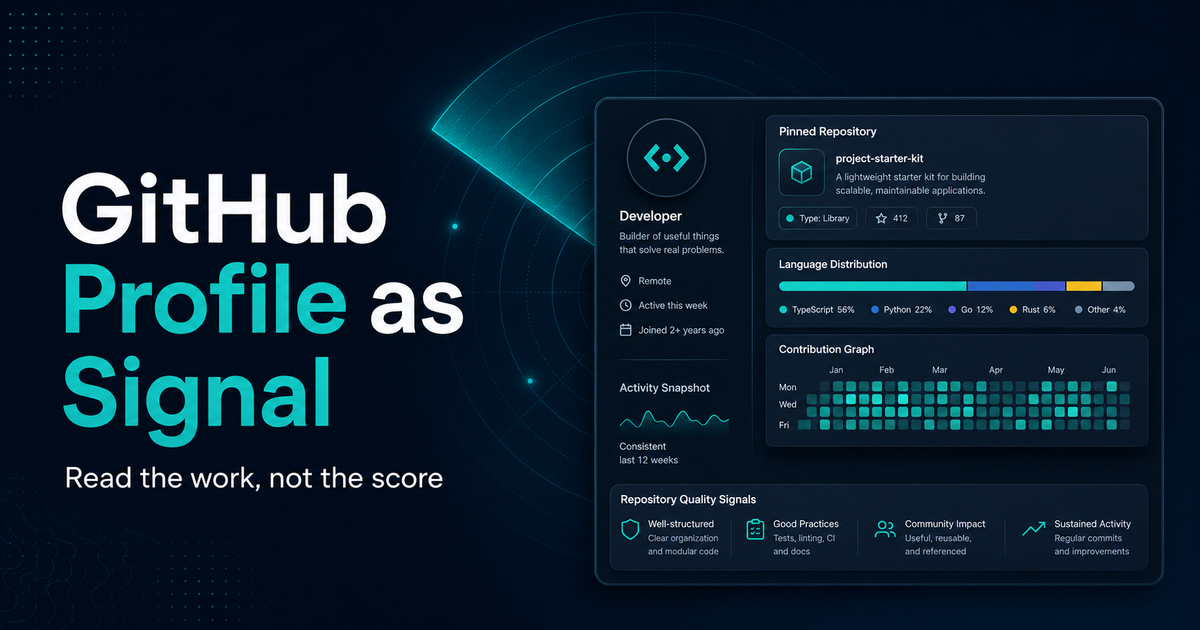
Use this guide when you already have a candidate, a GitHub URL, or a developer you are researching. A GitHub profile is public work evidence, not a hiring score. The difference is whether you read what the activity actually shows - pinned repositories, recent contributions, collaboration tone - or treat headline numbers as proof of skill.
This guide explains how to read a GitHub profile as a recruitment signal: what each field can mean, which numbers mislead, and how to avoid turning public activity into a shallow scorecard. For search workflows and a five-minute triage routine, see How to Find Developers on GitHub: A Recruiter's Guide. For strategy and limits, start with GitHub Candidate Sourcing: How Recruiters Can Find Technical Talent.
What's actually on a GitHub profile
GitHub has no recruiter dashboard. You are reading a public developer profile directly. Here is what you are looking at - and what is often missing.
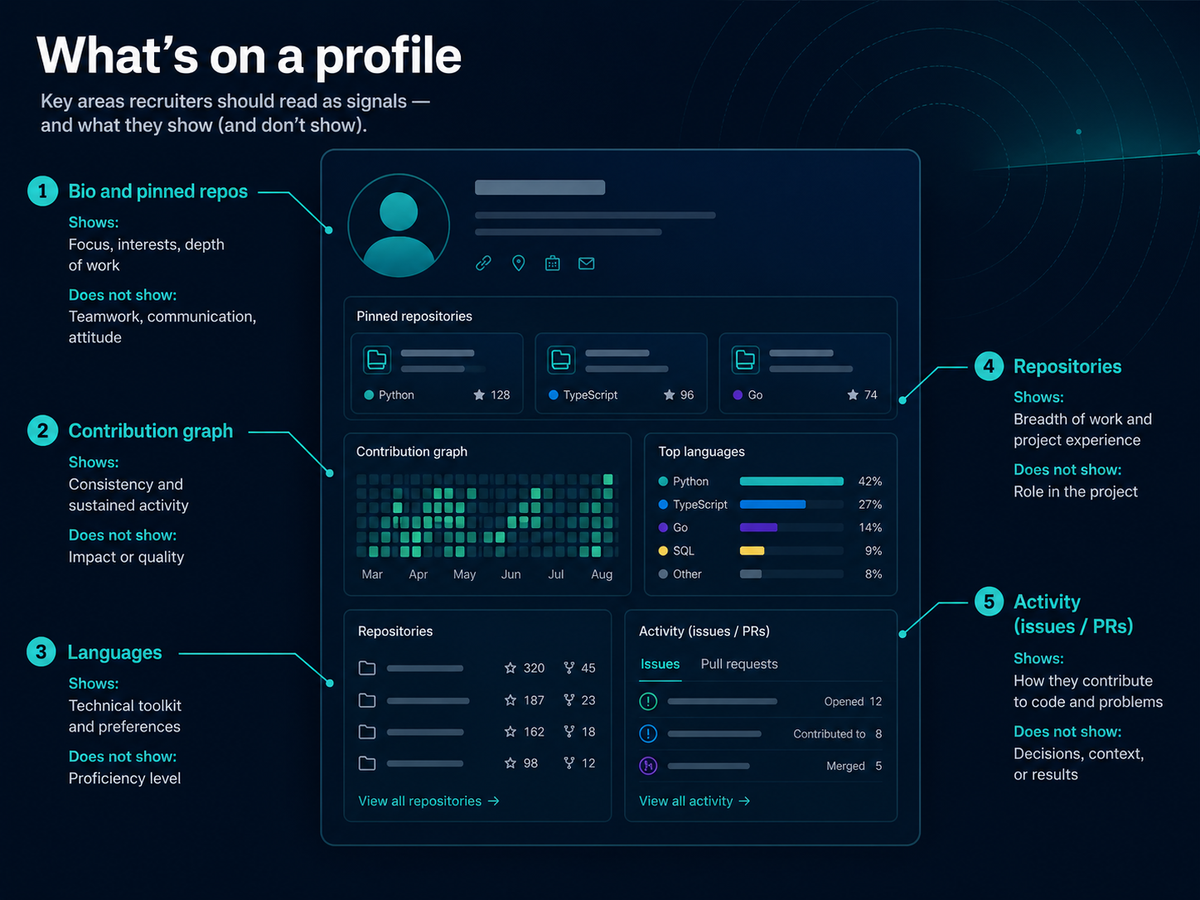
| Field | What it shows | What it does not show |
|---|---|---|
| Bio and links | Self-description, personal site, sometimes LinkedIn or Stack Overflow | Verified employment, seniority, or availability |
| Pinned repositories | What the developer chooses to highlight | Everything they have ever built |
| Contribution graph | Public commit activity over time on GitHub | Private employer work, local-only projects |
| Languages bar | Language tags on public repositories | Actual day-to-day stack if most work is private |
| Repositories tab | Owned and forked projects, READMEs, topics | Production systems behind company firewalls |
| Activity feed | Recent issues, pull requests, reviews, stars | Full collaboration history across all employers |
The profile is a curated window into public technical work. Most strong engineers also have years of invisible private code. Read the window; do not pretend it is the whole house.
Signals worth reading: repos, recency, languages, collaboration
Not every field deserves equal weight. These four areas usually give recruiters the most honest first-pass signal when read in context.
Pinned repositories
Pinned repos are intentional. They show what someone wants visitors to see first - side projects, open-source tools, portfolio work, or contributions they are proud of.
Strong signal: Pinned repos align with your role stack, have maintained READMEs, show original work (not empty forks), and include recent commits or releases.
Weak or neutral signal: Pinned repos are unrelated tutorials, years out of date, or forks with no meaningful commits. That may mean public GitHub is not where they work - not that they lack skill.
Recency and consistency
Look at the last twelve months on the contribution graph and recent activity feed. Steady public work in relevant technologies suggests current engagement with that stack in the open. Long gaps may mean private employment, career change, parental leave, or simply that GitHub is not their primary workspace.
Read recency relative to the role. A backend hire with quiet GitHub but active Stack Overflow answers in database tags may still be strong. Absence on GitHub is missing evidence, not negative evidence.
Languages and repository mix
The languages bar reflects tags on public repos, not a verified skills audit. It helps when several owned repositories consistently use technologies your role needs.
Useful pattern: Three or more owned repos in the last two years sharing a coherent stack (for example Rust systems tools, or TypeScript full-stack apps).
Misleading pattern: One tutorial repo from five years ago drives the entire language breakdown while everything else is unrelated.
Collaboration and communication
Issues, pull request descriptions, and review comments reveal how someone explains problems and responds to feedback. README quality matters too - can they document setup, trade-offs, and usage for another developer?
This signal supports team-fit hints. It does not replace interviews. Public open-source norms differ from every workplace.
Numbers that mislead: stars, commits, green squares, followers
Recruiters often over-index on visible counters. These numbers are easy to scan and easy to misread.
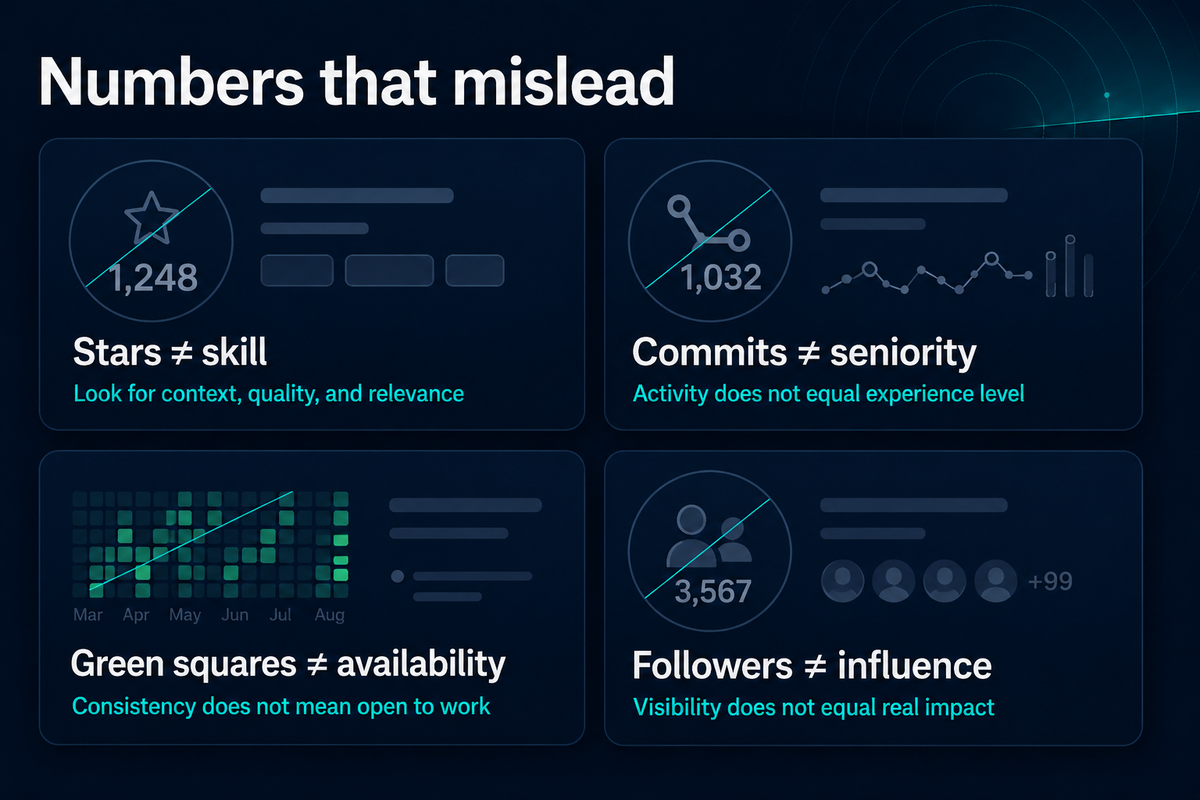
Stars on repositories. Stars measure interest in a project, not skill of every contributor. A famous library may have thousands of stars while a one-line typo fix from a passerby adds nothing to hireability. High stars on someone's personal repo can mean good marketing or a useful tool - not automatic seniority.
Commit counts and volume. Volume can reflect automated commits, rebases, trivial formatting changes, or CI bots. Without reading what changed, counting commits misleads. A senior engineer with one thoughtful PR may matter more than someone with thousands of low-context commits.
Green squares on the contribution graph. The graph only counts public GitHub activity. Private repos, employer GitLab, and local work do not appear. A sparse graph does not mean someone is inactive in engineering. A dense graph does not mean they are open to jobs or senior in your stack.
Followers. Followers reflect social reach on GitHub, not engineering depth. Influencers, tutorial authors, and maintainers of popular repos accumulate followers. Quiet specialists often have few.
Treat every counter as a starting question, not an answer. "Why does this number look high or low?" beats "This number qualifies them."
Three profile patterns: two useful, one misleading
These composite patterns illustrate how the same headline stats can point in different directions. Names and numbers are illustrative - the structure is what matters.
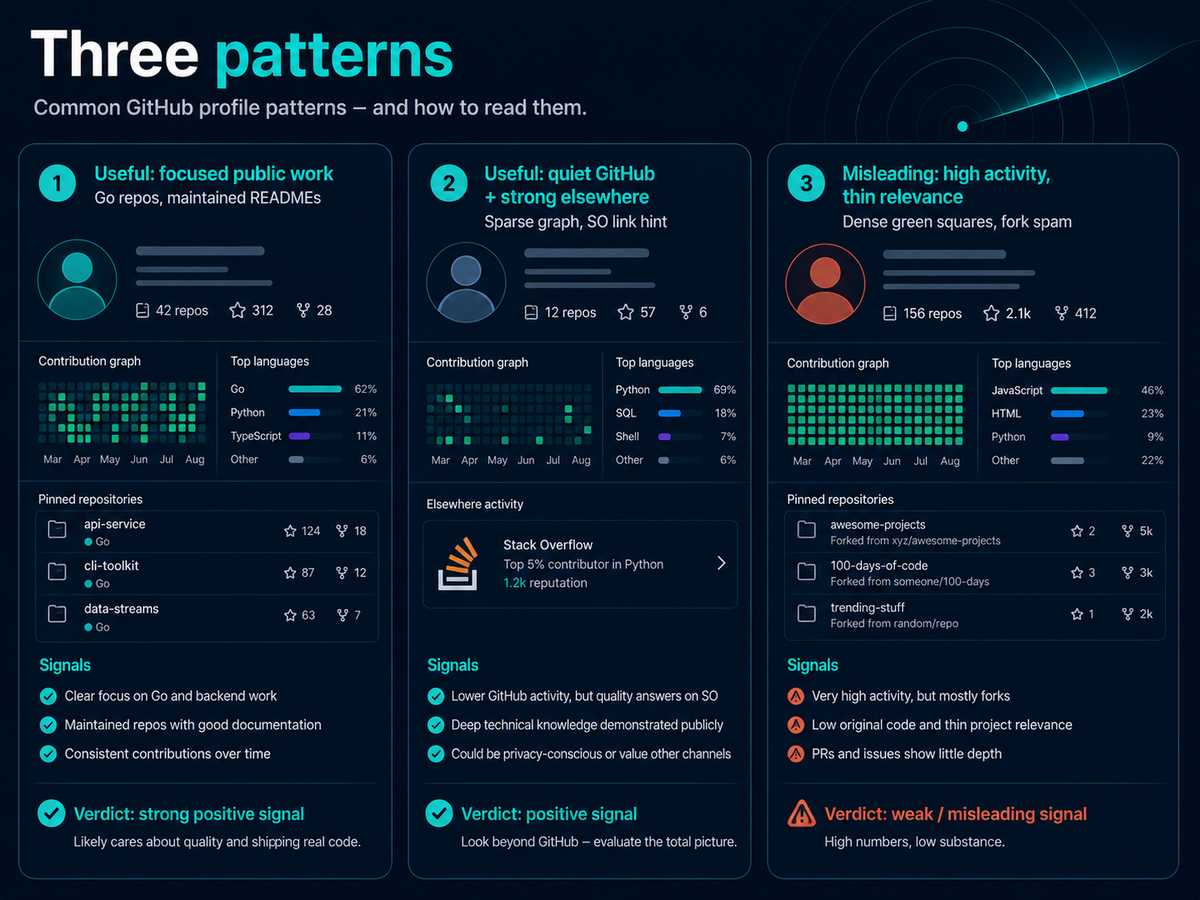
Pattern A - Focused public work (useful)
- Pinned repos: two backend services in Go with clear READMEs, updated in the last six months
- Languages: Go dominant across owned repos
- Activity: substantive PR reviews and issue threads on owned projects
- Contribution graph: steady but not extreme
Verdict: Public evidence aligns with a backend Go role. Worth shortlisting if cross-source checks support stack fit. Still requires conversation - public work is not a hire decision.
Pattern B - Quiet GitHub, strong elsewhere (useful)
- Pinned repos: one small side project from three years ago
- Contribution graph: sparse last twelve months
- Bio links to Stack Overflow with deep answers in
[postgresql]and a LinkedIn history in data engineering
Verdict: GitHub alone looks thin. Multi-source research shows concentration elsewhere. Do not pass on GitHub quietness alone. This pattern is common among engineers whose employers keep production code private.
Pattern C - High activity, thin relevance (misleading)
- Contribution graph: dense green squares
- Repositories: dozens of forked trending repos with minimal original commits
- Stars: high on a fork of a popular JavaScript boilerplate
- Followers: moderate
Verdict: Looks busy in a five-second scan. On closer read, little original work connects to a specialist hire. Activity without relevant depth creates false confidence. This is the GitHub equivalent of high Stack Overflow reputation spread across fifteen beginner tags.
What a GitHub profile still cannot tell you
Even when you read carefully, a profile has hard limits. The pillar article covers these in depth; they bear repeating because over-reading causes bad hires and missed candidates.
Private professional work. Most production code never appears on a public profile.
Seniority and level. Side-project volume does not map cleanly to staff engineer scope in large systems.
Job-search intent. Active GitHub users may be happily employed. Quiet profiles may be actively looking.
Team and culture fit. Public OSS collaboration style differs from your team's norms.
Performance under your constraints. Public repos show self-chosen work under self-chosen conditions.
For the full limits list, see what GitHub cannot tell a recruiter.
Common over-interpretation mistakes
Treating stars or followers as hire scores. Rank projects and reach, not individuals, without reading contributions.
Equating green squares with productivity. The graph is incomplete by design.
Assuming language bars equal résumé skills. They reflect public repo tags only.
Rejecting quiet profiles automatically. Missing public evidence is not proof of weakness.
Reading code before READMEs and discussions. For first-pass research, documentation and issue threads usually tell you more per minute than file diffs.
Ignoring cross-platform evidence. GitHub is one layer. Stack Overflow tag concentration, technical blogs, and professional history fill gaps GitHub cannot.
Confusing triage with interpretation. The five-minute triage routine decides shortlist, maybe, or pass. This article explains what the fields mean - use both, not one instead of the other.
How this feeds outreach
Profile reading supports outreach; it does not replace it. Move to contact when you can name specific evidence:
Reference real work. "Your repo [name] documents [specific problem]" beats "I saw your GitHub profile."
Match evidence to the role. Tie outreach to stack-relevant repos, contributions, or discussions - not generic praise for commit volume.
Cross-check first. LinkedIn for career context, Stack Overflow for community-validated depth, internal notes for prior touchpoints.
Stay honest about limits. If evidence is thin, say what you did find and why the role might still fit - or wait until you have more context.
Do not outreach because someone has many followers or a full contribution graph. Activity shows engagement with technical work in public, not availability or interest in your opening.
How Sonar Air approaches GitHub profile evidence
Sonar Air is a technical evidence research and candidate discovery platform for recruiters. It treats GitHub as one source in a multi-platform evidence profile - alongside Stack Overflow, Hacker News, Kaggle, and technical blogs. The product surfaces public work for recruiter review rather than collapsing activity into a single hire score.
Scans and shortlists link back to underlying evidence so sourcers can verify context before outreach. Role profiles help repeat the same interpretation standards across searches. Sonar Air Agents (in beta) can draft outreach and sourcing strategy from that evidence - always for human review, not autopilot hiring.
If your team evaluates platforms for this workflow, see Best GitHub Candidate Sourcing Tools for Recruiters in 2026 for selection criteria. Sonar Air offers a Free plan (€0) for one role and one scan per month; access is invite-only while self-serve billing is being tested - request access when you want to review public technical evidence on live roles.
Frequently asked questions
What can you learn from a developer's GitHub profile?
You can learn which technologies appear in public projects, how recently someone contributed in the open, how they document work, and how they collaborate in issues and pull requests. You cannot learn seniority in private systems, job-search intent, or full career history from GitHub alone.
Do GitHub stars mean someone is a good hire?
No. Stars reflect interest in a repository, not individual contributor quality. A project can be widely starred while a given person's contribution was minor. Read what they actually built or maintained.
What does a contribution graph tell a recruiter?
It shows public GitHub activity over time. Useful for recency hints when someone works in the open. Misleading when most work is private - sparse graphs are common among strong engineers at companies with closed codebases.
How is reading a profile different from a five-minute triage?
Triage is a fast shortlist, maybe, or pass decision using a consistent checklist. Profile signal reading explains what each field means and which numbers mislead. Use triage for speed; use this guide for judgment.
Can a quiet GitHub profile still be a strong candidate?
Yes. Many excellent engineers keep production work private or simply do not use GitHub for daily work. Treat quiet profiles as incomplete evidence and cross-check LinkedIn, Stack Overflow, and conversation - not as automatic disqualifiers.
Should recruiters read the code on every profile?
Usually not for first-pass research. READMEs, project descriptions, issue threads, and pull request discussion give sufficient signal for initial research. Deep code review belongs later in the process when a hiring manager or engineer validates fit.
How do you combine GitHub with LinkedIn or Stack Overflow?
Use GitHub for public technical work evidence, LinkedIn for career history and titles, and Stack Overflow for community-validated depth in specific technologies. No single platform tells the full story.
Is it legal for recruiters to review public GitHub profiles?
Public GitHub profiles and repositories are visible on the web by design. Recruiters commonly use them for sourcing research. If you store or process personal data, especially in the EU, your organization may have GDPR obligations. This is not legal advice; consult qualified counsel and your internal policies.
Final takeaway
Reading a GitHub profile as a recruitment signal means interpreting public work evidence with context - not scoring headline numbers. Pinned repos, recency, languages, and collaboration tell you more than stars, followers, or green squares.
Use GitHub to research and shortlist with eyes open about what is missing. Combine profiles with other public sources, run a consistent triage pass, and verify through conversation before you treat any signal as a hire decision. That is how GitHub supports better technical recruiting without becoming a visibility contest.
Sonar Air team
Writes about evidence-based technical recruiting and multi-platform developer sourcing at Sonar Air.
About Sonar AirMore from the blog
More articles on technical hiring are coming soon.
Back to blog